In today’s warehouse, there is a flood of data made available by software, automation systems and sensors. The technologies continuously deliver information, which is then displayed on a conventional dashboard. However, dashboards only provide a real-time display of what has happened or is currently happening. A human being must interpret the data, prioritize and implement the next steps, resulting in manual analyses, delayed decisions and unused potential.
AI in SAP® EWM completely changes this approach. Static evaluations are replaced with intelligent AI agents. Instead of just presenting information, they analyze relationships, identify deviations and guide employees through complex processes. But what does this look like in reality? And what does it mean for SAP® EWM? Let’s take a look at the warehouse management of tomorrow – perhaps already the warehouse management of today.
Contents:
SAP’s Autonomous Enterprise: Why an AI agent is more than just a dashboard
In the past years many companies have successfully invested in data platforms, reporting solutions and visualization. The problem is rarely a lack of data. More often than not, what companies lack is the ability to take the information coming from various systems and combine it in a way that allows them to make good decisions rapidly. Overcoming this fragmentation requires understanding AI as a company-wide function.
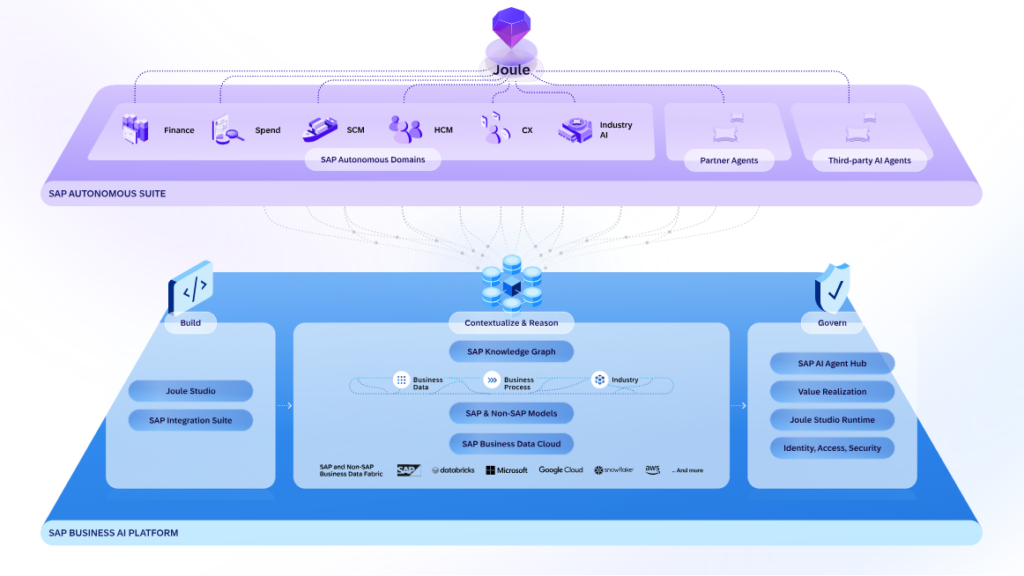
SAP answers this challenge with Autonomous Enterprise. Here, artificial intelligence is not understood as an isolated tool, but as a company-wide link that connects people, processes and systems in a single operational process.
At the center is SAP Joule, SAP’s AI copilot. Joule assists employees across different business units and links information coming from various applications. Behind the scenes? AI agents that not only respond to queries, but also carry out defined tasks such as analyses, coordination and routine tasks independently and assist in making decisions along the entire value chain.
When conditions change, the company can then respond as a whole. A problem in the delivery chain, for example, is not displayed in isolation on a dashboard. Instead, it triggers a coordinated response from planning, procurement and operations. The focus shifts from just presenting data to actively recommending what steps to take. In this model, however, control of the strategy, priorities and decisions ultimately remains in the hands of people.
SAP BTP and SAP Business AI Platform: The foundation for intelligent logistics
In order for AI agents to work usefully, they need access to data, processes and business logic. With the further development of SAP Business Technology Platform, or SAP BTP, SAP has created this necessary foundation.
Although the central integration and development platform will be retained in its familiar form, it has been specifically expanded to include AI functions and further developed into the SAP Business AI Platform. This now includes:
- AI models and agent functions
- Development tools for AI agents
- Governance and safety mechanisms
- Integration of business logic and company data
How does AI in SAP® EWM change warehouse management?
The Autonomous Enterprise with AI agents opens up new possibilities for SAP® EWM as well. While conventional warehouse management systems plan, control and document, artificial intelligence expands the operative ability to make decisions.
Several developments are already emerging today:
These developments are supported by SAP through an AI-based work environment called SAP Joule Work. In the spirit of the Autonomous Enterprise, users no longer have to toggle back and forth between different programs, dashboards and process steps but will in future enter their goal in a chat window in natural language. The platform independently bundles the relevant information, processes and AI agents and coordinates their interplay across SAP® and non-SAP® systems.
One of the central elements in SAP Joule Work are “spaces”, which are dynamic, AI-generated work areas that adapt automatically to the current task. Depending on the context, relevant data, open tasks, recommended actions and available AI agents are combined in a common work environment. For warehouse managers, this means that decisions are no longer based on individual reports or isolated systems, instead coming from an intelligent contextual work space.
This changes the central question in the warehouse from “What is happening now?” to “What should we do next?” The warehouse of the future will not become less human as a result. Instead, focus will shift increasingly to collaboration between people and artificial intelligence. AI agents not only provide prepared information, but actively provide support by analyzing situations, prioritizing measures and making operational decisions. This lightens the workload for employees and frees capacities for tasks that create value. What does this support look like in real life? One example is the AI Delivery Pilot.
AI Delivery Pilot: An AI agent for SAP® EWM
Rising automation means growing complexity in many warehouse processes. On top of this, companies are under tremendous time and cost pressure. Neither warehouse managers nor employees have all the knowledge needed to analyze and find a solution for every supply blockage, system error or process interruption by themselves. The result is often time-consuming procedures with extremely long checklists, detailed user manuals and long waits for expert support. Solutions are needed that not only display the data, but recognize relationships, set priorities and translate them into clear options in terms of steps that can be taken.
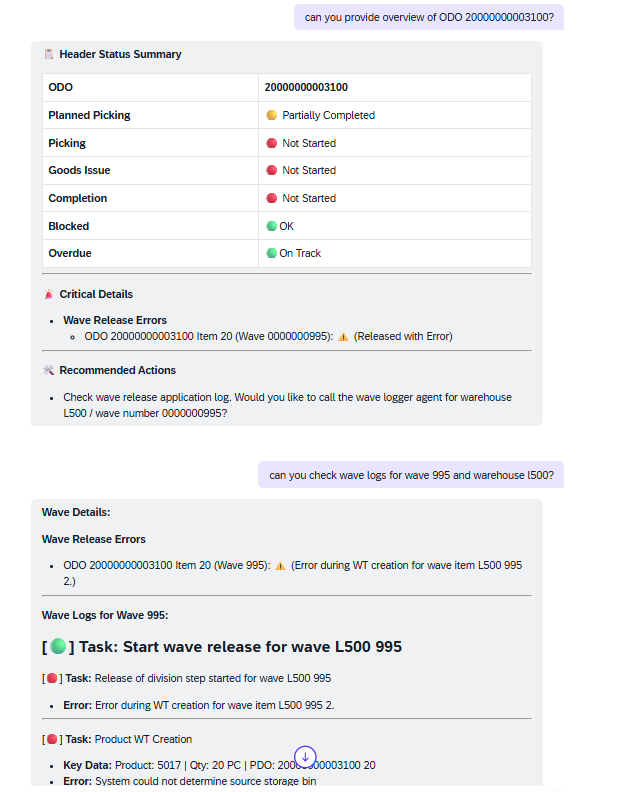
The software AI Delivery Pilot was developed to fill exactly these gaps. The AI agents analyze delivery data automatically, identify relationships within a few seconds and present the information in an intuitive chat interface. Supervisors and employees get a rapid overview of:
- Current information on delivery status
- Deviations in process
- Possible causes of errors
- Specific recommendations for actions
The real added value is not just identifying errors. AI Delivery Pilot assists in the analysis of what caused the error, which is invaluable in helping to prevent recurring errors in the long run. This AI solution therefore provides transparency, knowledge and recommendations, which employees can then use to make decisions.
Another major advantage of the AI Delivery Pilot is that it directly accesses the database of the productive SAP® EWM system. As it works, the AI agent not only takes standard processes into account, it also accounts for all the company-specific requirements that were mapped during implementation. The AI pilot uses the custom rules for stock determination and considers them when recommending actions. If items with a better best-before date are preferred for overseas deliveries due to the long transport routes, this knowledge is automatically incorporated into the decision support of the AI Delivery Pilot.
The first real-life applications are showing clear advantages. Problems whose analysis used to mean several hours of work can now be analyzed within a few minutes. At the same time, the work required for documentation and training is significantly reduced because expert knowledge is directly available through the AI agent.
AI Delivery Pilot’s advantages at a glance
AI Delivery Pilot shows definitively how AI in SAP® EWM can create specific added value.
Discover how the idea for AI Delivery Pilot came about, which SAP® technologies are used and the challenges that the software solves in this video.
From intelligent to autonomous warehouses
Logistics and IT teams work under time pressure and in increasingly complex SAP® EWM system landscapes. Though development is still in its infancy, the direction is clear: While dashboards provide transparency, AI agents create the capacity to act.
Today’s AI agents such as AI Delivery Pilot demonstrate how data, processes and expertise can be intelligently linked. They streamline analysis, accelerate decisions and make expertise available to the entire organization.
In Autonomous Enterprise, these AI agents connect business data, processes and human intelligence into one strategic overall system. SAP BTP creates the technical foundation, the SAP Business AI Platform delivers the context and governance, Joule Studio enables the development of AI agents, and SAP® EWM remains the operational heart of warehouse processes.
FAQ – Frequently asked questions on AI in SAP® EWM
The integration of AI in SAP® involves using artificial intelligence in SAP® Extended Warehouse Management. The goal is to automate the analysis of warehouse data, detect anomalies early on, and to support the people working in the warehouse with intelligent recommendations for actions and decisions.
AI agents are intelligent software systems that bring together data from various applications and processes, analyze it and use it as a basis to execute tasks or make recommendations. In warehouse management, AI agents help analyze disturbances, prioritize measures and provide access to expertise.
SAP Joule is SAP’s AI copilot. It supports those working in the warehouse with bundled information from various business applications, providing faster access to the relevant data. By interacting with AI agents, Joule can help users to analyze problems, understand relationships and to come up with suitable measures.
For the development and operation of AI agents in warehouse management, like the AI Delivery Pilot, various SAP ® technologies come together.
- SAP® EWM as the operative data base
- SAP BTP as the integration and development platform
- SAP Business AI Platform as the AI platform
- SAP AI Core for the execution of AI models
- SAP Joule Studio for the development of AI agents
- SAP Build Process Automation for the orchestration of processes
Autonomous Enterprise is SAP’s vision for the next generation of business software in which AI agents, business processes and company data work together intelligently to execute tasks automatically, accelerate decisions and continuously optimize processes, while people keep control over strategies, priorities and governance.
Would you like to find out which AI applications would make sense in your SAP® EWM landscape? Let’s do the analysis together and find out where AI agents can create the most value for your warehouse processes.
The author of this article