
When the handover is imminent, an automated logistics system might seem complete: the conveyors, shuttles, sensors, drive units and work stations are all installed, the cables are all laid, and the software is ready. However, this is the beginning of an important phase that has a powerful impact on the future success of the system. The job of Controls Commissioning is not just to check whether individual components function properly, but to make sure that they all work together reliably. Step by step, the mechanical and electrical components combine with the software to give rise to a stable material flow. In this blog, we’ll show you what the technical fine-tuning looks like and why the final stretch leading up to the go-live is crucial.
Why Controls Commissioning is more than one final test
Controls Commissioners call themselves “flowmasters”, and not without reason. They make sure that the material flow, flow of information and technical processes all engage perfectly with each other. The team’s motto goes something like this: “With the flowmasters, we go faster and avoid disaster.” It’s a humorous way of describing the sophisticated job they do: bringing machines, control systems and software to life step by step.
During planning, every step is defined. As the plans are rolled out on the system, it becomes clear whether they are also going to work in reality. Sensors must signal at the right moment, motors must respond properly, safety areas must be maintained, and the PLC control systems must make the right decisions. When a container is identified, this information needs to be sent to the right control system at the right time. Then a drive system responds, a switch engages, a shuttle begins a run, or a work station gets its next task.
Getting this chain to function without any interruptions requires technical know-how on many levels. Mechanical engineering, system installation, and software engineering provide the foundation for successful commissioning. Controls Commissioning ensures that the PLC control systems, sensors, motors, shuttles and visualization systems work properly with each other during operation. Only after the entire system has been tested, optimized and successfully commissioned is the project ready for the customer.
PLC, signal times and milliseconds: what really matters
In modern logistics centers, countless processes must run simultaneously, and many decisions must be made rapidly. A signal comes in, is processed and triggers the next step. Even a small delay or an incorrectly interpreted return message can impact the material flow, which is why the Controls Commissioning team pays particular attention to signal times, releases, interfaces and the sequence of individual actions.
Here’s where things get technically interesting. You can’t see every problem right away. What causes an issue might only show up under a certain system load or when several systems are active at the same time. This is where the technical detective work begins: Signals are tracked, statuses are compared, logic is tested and processes are isolated step by step. Is the problem with the sensors, cabling, control system or an interface? Or is it due to the interplay of several factors?
Team perspectives: Responsibility up to the handover
Controls Commissioning Team Lead Patrik Pichler explains how much coordination and technical responsibility is packed into this phase. Patrik has worked at KNAPP since 2017 and has been the team lead for his team’s projects since 2021. Coordination, project management and employee development are just as much a part of his responsibilities as the technical focus leading up to the handover of the system to the customer.

"One of the nicest aspects of my job is working with my colleagues. Seeing how they progress with every project, develop new skills and exceed themselves is part of what motivates me every day."
Patrik Pichler, Team Lead, Controls Commissioning
This is a good explanation of what goes on in Controls Commissioning: The work requires a high degree of technical precision but is always done in a team. In international projects especially, many people, specialist departments and perspectives must work together to achieve the stable operation of the installation.
From the individual test to the stable overall system
The startup of the system is done in steps. First, the individual components are checked: sensors, motors, switches, scanners, safety functions or control consoles. Then, whole system areas are tested. Once these are operating stably, the interplay of larger parts of the system is tested. This way, the system grows in a controlled manner from individual signals to an end-to-end material flow. An important aspect of this phase are tests conducted under realistic conditions. The teams simulate typical processes, high workloads, errors and special cases.
What happens when a container cannot be read?
What does the system do when an area is blocked momentarily?
How fast can the system return to normal operation?
Once the system can deal with situations like this, it is ready for operation.
Technology comes to life
Christoph Pendl is also no stranger to working directly on an installation. He has worked as a technical expert at KNAPP since 2011 and got his start as an apprentice mechatronics technician, with an emphasis on PLC technology. Today, he supports the team on installation sites and works closely with developers, especially with technologies such as the picking robot Pick-it-Easy Robot or the high-powered Evo Shuttle storage system. Because the effects are immediate, he finds technical solutions particularly satisfying to work with.
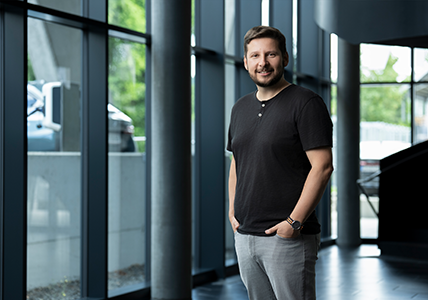
“PLC technology is fun for me. There are a lot of small adjustments or solutions that you develop on your own, and what’s really cool is that you can see their effects right away.”
Christoph Pendl, Technical Expert, Controls Commissioning
Being up close to the installations makes the work in Controls Commissioning special. Solutions arise not just on the computer monitor, but in real life – in direct interplay with mechanical and electrical components, software and real material flow. When adjustments are made, the results can be seen immediately. A process becomes more stable, a transition cleaner, a malfunction traceable.
Experience gained is poured into the next project
Controls Commissioning does not stop with the individual project. Experience gained from tests, optimizations and error analyses flows back into the products, standards, processes and tools. Every technical challenge is a lesson learned, and the knowledge gained is valuable for future installations. Every startup therefore becomes a source of information for the next project.
It’s this combination of technical know-how, problem-solving expertise and teamwork that is what Controls Commissioning is all about. Controls Commissioners connect the mechatronic systems with the software solution and ensure that the thousands of parts give rise to a coordinated overall system. Shortly before the go-live, they make sure planning, development and the implementation fit well together. And the flowmasters ensure that a stable material flow arises from the functioning technologies.
A day in the life of...
Would you like to know what Controls Commissioning looks like in reality? In these videos, Patrik and Christoph take you behind the scenes of their day-to-day work. You can also discover more in our blog post “What Does a KNAPP Controls Commissioning Engineer Do?”.

You are currently viewing placeholder content from Google Preferred Sources. To access the actual content, click the button below. Please note that this will result in data being shared with third parties.
More Information