
Warehouse management systems (WMS) and warehouse control systems (WCS) reliably help many companies run their operations for many years. However, outdated IT hardware and software, increasing automation, requirements for omnichannel fulfillment, increasing quantities of data and the reliance on a few suppliers who still have the expertise to maintain these old customized systems are pushing these legacy IT landscapes to their limits. WMS modernization offers a structured approach to renewing existing warehouse systems – without lengthy interruptions in operation or the need to entirely replace an old warehouse with a new one. Find out in this blog post when a WMS retrofit is a good move, how you benefit from these projects, what the possible risks are and why SAP® EWM is the right choice to achieve an integrated WMS and WCS platform.
Contents
1.Stay put or move on? When WMS modernization makes sense
2. Brownfield instead of greenfield: The pros and cons of WMS modernization
3. What to keep in mind when it comes to WMS retrofits
4. WMS modernization: Duration and costs
5. WMS retrofit success: Rethinking instead of copying processes
6. Test and change management: Underestimated success factors in WMS modernization
Stay put or move on?
When WMS modernization makes sense
WMS retrofit refers to the brownfield approach to modernizing an existing system. In other words, WMS modernization does not require rebuilding a warehouse from scratch. Existing logistics structures and processes are kept, but they are integrated into a new WMS solution and optimized.
The reasons to implement a WMS retrofit are manifold. In practice, it’s usually a combination of several technical as well as operational factors that indicate the need for a retrofit.
Technical indicators
In addition to the technical red flags, changing operational requirements may also necessitate flexible and transparent processes:
In short: If existing systems only meet the technical and operational requirements with compromises, then a future-proof WMS retrofit is worth the investment.
Brownfield instead of greenfield:
The pros and cons of WMS modernization
A WMS retrofit project differs completely from a greenfield approach, as it takes place during ongoing operation. Even though this naturally comes with a certain degree of complexity and risk, a retrofit opens up new ways to optimize existing structures exactly where it’s needed instead of starting from scratch.
What to keep in mind when it comes to WMS retrofits

The most critical moment is go-live. Compared to greenfield projects where new systems are installed step-by-step, retrofits take place in one fell swoop. In this so-called big bang migration, the WMS is started up in real operating conditions in one go.
In B2B, reducing deliveries temporarily can reduce risk, but often leads to subsequent workload peaks. In B2C, reducing the volume is simply not possible due to end customer expectations. Because of this, it’s important to have a robust backup plan so that in the worst case, resetting the old system is fast and feasible both from a technical and organizational point of view.
To reduce the risk further, it’s extremely important to conduct comprehensive tests in advance, such as integration, process, load and end-to-end tests. A common pitfall is underestimating the time and resources required for these tests and approaching them unsystematically.
The better prepared you are, the higher the chances for overall project success. The existing documentation on interfaces, process and operating concepts, for instance, is often incomplete or outdated. It has to be systematically checked and updated to achieve a reliable overview of the system’s actual condition. This is the only way to identify risks early on and keep them under control.
WMS modernization: Duration and costs

Since WMS retrofits involve intensive analysis, integration, test and migration phases during ongoing operation, they are not a short-term IT project, but a transformation project for the long term. The focus moves away from technical implementation to a comprehensive operational upgrade of the warehouse.
In practice, these projects usually take 12 to 24 months to complete and the level of investment strongly depends on the particular conditions at hand. Influencing factors often include the existing degree of automation, the necessary scope of process changes and the quality of the existing documentation.
WMS retrofit success: Rethinking instead of copying processes

Warehouse management and warehouse control systems that have been in operation for a long time usually exhibit a high level of customization. Some adjustments might have been necessary to meet specific requirements, others developed based on trade-off decisions made in the past. A WMS retrofit offers the chance to carefully scrutinize the existing processes.
For this purpose, the old system should serve only as a technical reference, not as a blueprint for future processes. Comparing the current and target processes helps find the right focus:
- Which requirements are still relevant today?
- Which requirements do the standard SAP® functions cover?
- How can I achieve the right balance between tailoring SAP® EWM to business needs (maintainability) and fulfilling the business purpose (productivity, quality of business processes)?
- Which changes can the business handle through change management?
A structured fit gap analysis helps to find the right ratio of proven customized processes and standard SAP® functions. This way, you can precisely determine the scope of the project. Without this analysis, old and new logic is mixed, causing project creep, such as delays, instability and an exceeded budget.
3-point checklist for new warehouse requirements
Test and change management:
Underestimated success factors in WMS modernization

Retrofits are usually carried out according to a big bang approach, which is why structured test management is required. Unit, integration and acceptance tests make sure that all components interplay seamlessly. Using emulations, you can identify risks early on and avoid unplanned downtime.
Change management is also essential, as the introduction of new systems alters work processes as well. To help employees accept the transition, concentrate on clear communication, training and organizational preparation. Tidying up old physical structures in the warehouse also contributes to implementing new processes consistently.

SAP® EWM retrofit for
an integrated WMS and WCS platform
During a WMS retrofit, existing warehouse structures are modernized without affecting stability and with a focus on upgrading the system architecture. SAP® Extended Warehouse Management, SAP® EWM for short, makes this a reality, systematically resolving issues arising from the weaknesses of old IT landscapes, such as fragmented systems, complex interfaces and inconsistent data.
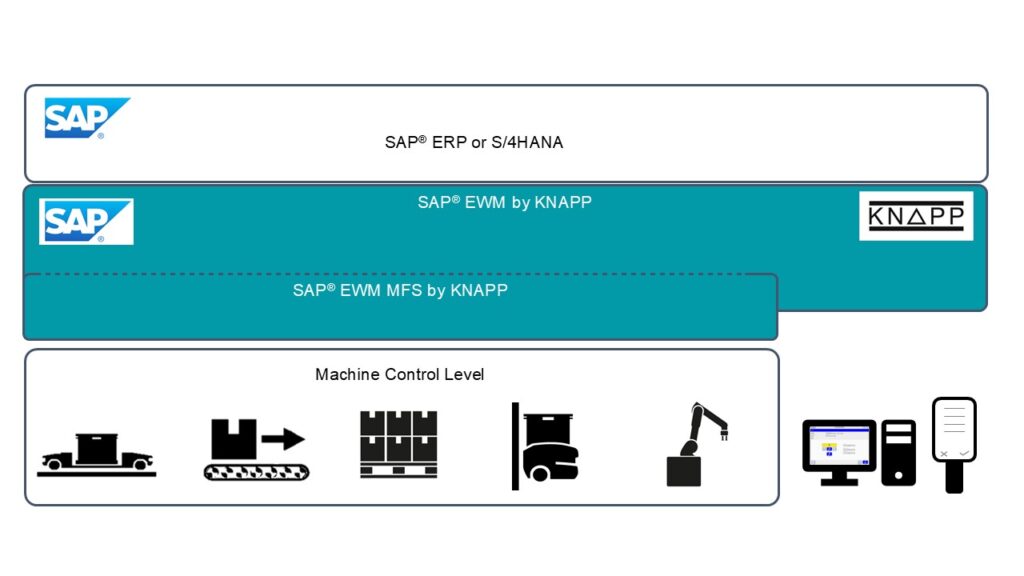
Compared to classic best-of-breed approaches, SAP® EWM integrates WMS and WCS functions in a single platform. It includes an embedded material flow system (MFS) to control automated warehouse areas via the WMS. This eliminates the need for external WCS systems.
Fewer interfaces result in:
- External WCS becoming dispensable
- Less complexity and reduced integration expenses and effort
- Increased stability of the system architecture and less maintenance
The integration is especially important with regard to retrofits, since complexity has to not only be mapped but reduced overall.
At the same time, SAP® EWM supports the classic retrofit approach to maintain proven structures and implement optimizations gradually. Existing material flows and automation solutions can be integrated without having to be entirely re-implemented. The transformation process is systematic and involves a low level of risk to operations.
Another major advantage of the system is its modularity. Functions can be individually activated and expanded depending on the warehouse’s level of automation and requirements, allowing a smooth, step-by-step transition rather than one that is marked by interruptions.
Thanks to integrated end-to-end processes, SAP® EWM not only creates stability and transparency, it also offers the coherent dataset required by today’s AI applications, such as transparent process chains, fewer interfaces and consistent data models. An SAP® EWM retrofit forms the technological and data-centric basis for long-term, data-driven warehouse optimization that allows future AI applications to be integrated successfully.
Ready to implement an SAP® EWM retrofit?
An SAP® EWM retrofit is more than just migrating systems. Opting for it is a strategic decision to achieve stable processes, reduce interfaces and make your warehouse IT landscape fit for the future using a brownfield approach. To achieve the most successful outcome, it takes the right technology as well as competent, experienced SAP partner who understands your IT and logistics requirements and implements retrofit projects reliably during ongoing operation.
Drop our SAP® EWM experts a line and find out how they can support your endeavors in a low-risk and systematic manner – from organized preparation to stable go-live.
Are you planning a WMS retrofit?

You are currently viewing placeholder content from Google Preferred Sources. To access the actual content, click the button below. Please note that this will result in data being shared with third parties.
More Information