
Decentralized logistics networks are nothing new. Instead of relying on a few central distribution centers, companies are now utilizing a dense web of regional warehouses, production supply locations, temporary hubs and third-party logistics partners. However, all of these locations vary greatly in size, throughput and process maturity, meaning that traditional warehouse management systems are often several sizes too large for these warehouses.
That’s where SAP® Logistics Management comes in. SAP® LGM is a cloud-native software solution that allows warehouse operators to standardize their logistics processes for multiple decentralized locations. This post will outline when to use SAP® LGM, compare and contrast it with SAP® EWM and show how both solutions work together to create a future-proof SAP® logistics architecture.
SAP® EWM’s little brother:
Meet SAP® Logistics Management
SAP® Logistics Management is a cloud-based SAP® solution for controlling warehouse and transport processes at small and medium-sized logistics centers. The software is designed to standardize process execution, not to perform deep optimization or customization of processes.
SAP® LGM takes care of central operational logistics functions, including:
- Goods-in and putaway
- Picking and packing
- Shipping
- Basic transport dispatching
The solution follows a fit-to-standard approach. Any required expansions or integrations are implemented through SAP BAIP – the SAP Business AI Platform (formerly known as SAP Business Technology Platform) – keeping the core updatable, easy to maintain and stable over the long term and allowing users to efficiently expand logistics networks without bogging down small locations with too much tech.
Therefore, SAP® LGM isn’t an alternative to SAP® Extended Warehouse Management (SAP® EWM) in complex or highly automated distribution centers. However, it bridges the gap between simple stock management and all-out warehouse management systems by serving as a lean, scalable execution layer for decentralized logistics networks.
When comparing SAP® solutions, SAP® SRM (Stock Room Management) is also worth mentioning. Both SAP® LGM and SAP® SRM address simple warehousing scenarios. However, they have very different scopes and strategic orientations. SAP® SRM supports extremely simple processes directly in SAP S/4HANA and is ideal for autonomous single warehouses requiring little coordination. SAP® LGM, on the other hand, is explicitly intended for decentralized logistics networks and providing transparency across several locations.
Comparison of SAP® EWM and SAP® Logistics Management
| Criterion | SAP® LGM | SAP® EWM |
| Complexity / warehouse execution | Low to medium: processes with low or moderate complexity, no automation | High: complex processes, automation, multimodality |
| Warehouse processes / warehouse execution | Basic processes such as goods-in, picking, stock movements | Complex functions such as cross-docking, quality control, yard management, automation |
| Flexibility and expandability | Faster rollouts thanks to low complexity | Extremely flexible with comprehensive expansion options |
| Architecture | Completely cloud native, SaaS, SAP BAIP (formerly SAP BTP) | On-premise / cloud / embedded / sidecar solutions |
| Integration/interoperability | Planned for hybrid landscapes with EWM/TM, seamless integration | With existing solutions, already established |
SAP® Logistics Management in practice
Deciding whether to use SAP® LGM in the warehouse is more than just a question of functions. It’s a question of when and where SAP® LGM adds the most value. Next, let’s take a look at which logistics environments the module is best for, how it solves typical challenges and how it can be integrated into existing SAP® logistics landscapes.
Which logistics environments benefit from SAP® LGM
SAP® LGM is at its best wherever processes need to be standardized across multiple locations while remaining simple. Typical characteristics of these logistics systems are:
- Mostly manual processes
- Little to no automation
- Moderate throughput
- High need for standardization across multiple locations
With that in mind, here are some typical use cases for SAP® LGM:
- Regional warehouses
- Production logistics systems with medium complexity
- Satellite warehouses and external warehouse locations
- 3PL hubs that need to be connected quickly
SAP® LGM was created for these logistical challenges
Decentralized logistics networks pose the same challenges again and again, and SAP® LGM is designed specifically to address them.
Low process transparency at small locations
High manual effort and more errors
Slow integration of new locations
Limited cooperation with carriers
Intense training required for new personnel
Integration scenarios with SAP® LGM
Integration is one of the guiding design principles behind SAP® LGM. The solution was created to be part of a heterogenous SAP® logistics landscape, not an isolated system, so typical integration scenarios don’t follow a set pattern.
Integration with SAP S/4HANA
SAP® LGM connects to SAP S/4HANA as a central, leading ERP system. Master data, documents and stock-relevant bookings are exchanged using standardized interfaces.
Typical scenarios include:
- Centrally managing master data, documents and stock
- Performing warehouse and transport execution in SAP® LGM
- Keeping financial and management accounting in the ERP
Integration with SAP® EWM
In multi-level logistics architectures, SAP® LGM and SAP® EWM coexist:
- SAP® EWM for centralized, highly automated distribution centers
- SAP® LGM for regional warehouses, depots or production supply locations
- For stock alignment and transport coordination between locations
With this combination, every site gets exactly the system that meets its requirements.
Integration with transport and carrier networks
SAP® LGM supports transport execution and cooperation with carriers through the SAP Business Network thanks to the following features:
- Tendering and confirmation of shipments by the carrier
- Real-time transport status reports
- Seamless exchange of transport documents
Using SAP® LGM allows companies to respond faster during their day-to-day operations than they would with email or Excel-based communication.
Integration through SAP BAIP (formerly known as SAP BTP)
SAP BAIP serves as an integration and expansion layer for SAP® LGM by:
- Connecting non-SAP® systems or 3PL platforms
- Enabling custom workflows and checks without intervening in the core
- Offering event-based integration and monitoring
This approach supports clean core principles and long-term update stability.
So what exactly do I need?
SAP® Logistics Management and choosing the right SAP® modules
The availability of so many SAP® logistics begs the question: Which systems do I really need?
SAP continuously invests in cloud-native logistics solutions and modular architecture. SAP® LGM was designed to complement the existing portfolio by bridging the gap between ERP execution and high-end warehouse automation. As a cloud-native execution layer, SAP® Logistics Management is ideal for logistics sites with a level of complexity between simple stock solutions and classic WMS systems.
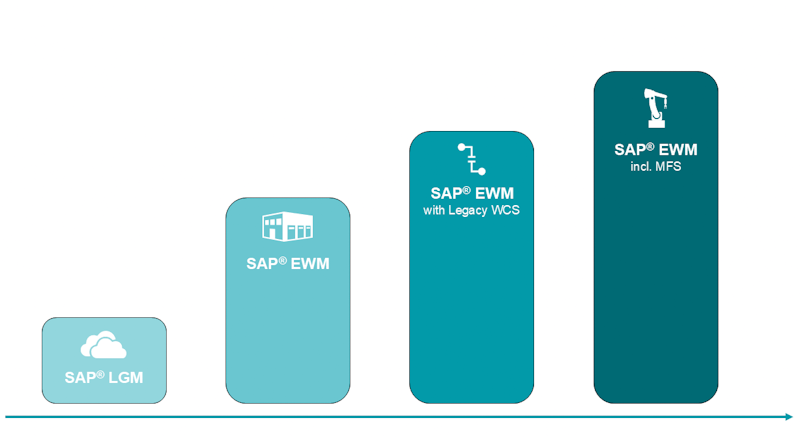
Instead of a one-size-fits-all concept, SAP is taking a different approach: multi-level logistics. By combining SAP® LGM with the appropriate WCS scenarios, legacy systems or SAP® EWM with MFS, each site will have exactly the scope of functions it actually needs while maintaining an overall end-to-end SAP®-based logistics landscape. Over the long term, this approach promotes resiliency, scalability and profitability – all of which are key requirements for today’s global logistics networks.
Do you want to learn how SAP® Logistics Management fits in with your strategy? Discuss your individual requirements with one of our experts today!

You are currently viewing placeholder content from Google Preferred Sources. To access the actual content, click the button below. Please note that this will result in data being shared with third parties.
More Information