
Returned goods are a major part of everyday e-commerce processes, with the fashion industry often facing a returns rate of 30 to 50 percent. For retailers, returns translate into increased costs and stress to get the goods back on the market quickly. The key to economical processes and satisfied customers is efficient returns management.
But how can this be achieved? In this blog post, we offer strategies for mastering the toughest challenges in reverse logistics and present technologies and automation solutions that optimize the return process to lower costs, raise efficiency and create real value for customers and your business.
Returns management in logistics: the challenges
High percentage of returns
Long lead times
Increased complexity in the warehouse
High customer expectations
Returns management: Outsource or keep in house?
Many retailers have to make the tough decision on whether to keep their returns processing in the company or outsource it to a 3PL provider. When outsourced to a partner, the partner processes and repacks the returned goods and sends them back to the warehouse. This might seem convenient, but often takes a long time. For the fashion industry or other retail sectors, outsourcing is therefore not a viable option as trends change dynamically. If returns are handled in-house, the returned goods are delivered to the warehouse directly, opening up many opportunities for economical and efficient returns management:
Higher chance of re-sale
Return-first principle
More sustainable
Fast release of stock
Optimum load throughout the day
Strategies for efficient reverse logistics
The key to maximizing efficiency in returns management is choosing the right process and technology to do the job. In the following, we will explain how returned goods are received and processed in a warehouse and then elaborate on two approaches that make returns handling more efficient.
Incoming returned goods
- The returned goods arrive at goods-in in shipping cartons, are conveyed to work stations manually or automatically and then received individually by scanning their codes.
- At the work stations, the item quality is checked and assigned a quality status.
- If there is a deficiency, the item is reconditioned for sale. If an item must be transported to another location in the warehouse, it is conveyed by a sorter system or conveyors to its destination.
- When the return is in perfect condition, it is repackaged for sale.
Efficient returns handling using a pocket sorter system
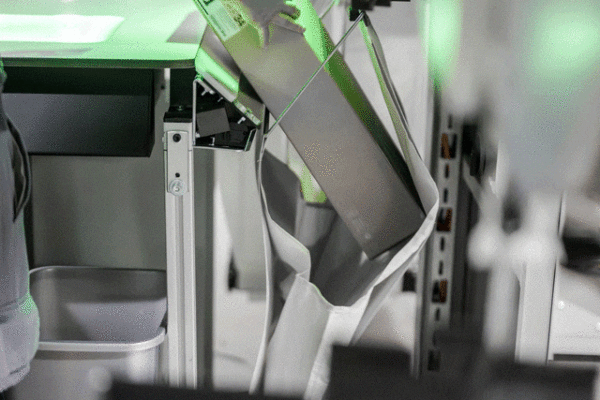
- At intelligent work stations such as our Pick-it-Easy Pocket work stations, the returns are recorded individually and then placed into pockets by employees or a robot.
- The items allocated by the system to the pockets are tracked precisely in the dynamic buffer and are ready to be shipped at any time.
- These returns are preferentially drawn upon for processing orders and are automatically retrieved from the buffer and combined with other items in the proper sequence for new orders.

Efficient returns handling using a shuttle storage system
- During decanting of the returned goods, mixed containers are created, which are controlled by intelligent software in the background based on defined rules, for example, that the mixed container may only contain one white T-shirt in size M. This ensures that fewer errors are made in the downstream picking process.
- The mixed containers are then automatically allocated to the ideal storage locations in the shuttle system.
- When an order is placed, the returned goods are automatically retrieved from the buffer and combined with other items in proper sequence for new orders. Thanks to intelligent work stations featuring user-friendly interfaces and two zero-defect strategies, picking can be carried out without errors, even for mixed containers.

Data beefs up efficiency in reverse logistics
To master today’s challenges in returns management, you need software. Using a powerful warehouse management system (WMS), you can keep an eye on returns processing and classify products to be fast movers or slow movers and reserve the best storage locations for returns. Once a returned good is received, the ERP system is notified of the number of items in stock, ensuring that goods are quickly available again online. In addition, data analyses and clear dashboards provide important information on returns rates and lead times to help make precise prognoses.
The takeaway
With efficient and transparent reverse logistics, you’re in a strategic position to satisfy customers, which leads to long-term customer retention and higher revenue. If you optimize your processes, work with data and use the right technology, you can turn returns management into a solid competitive advantage and a core element of your customer experience strategy.