
Smart Packing Patterns by KiSoft Pack Master
Perfectly calculated, perfectly stacked
From the online shop to the big supermarket: Every store or customer group has their own requirements, so every delivery deserves the optimal packing pattern. Whether packing for store delivery or for e commerce shipments, KiSoft Pack Master computes the ideal packing pattern for each load carrier, from pallets and roll containers to totes. This optimizes the entire packing process from start to finish. The important question for logistics is: How can outgoing deliveries be assembled to make unpacking at their destination easy and efficient, without transporting unnecessary volumes?
Packing patterns calculated by KiSoft are the answer: They determine tailored packing instructions for every delivery, plan the optimal structure for the load unit and specify the exact retrieval sequence for the items.
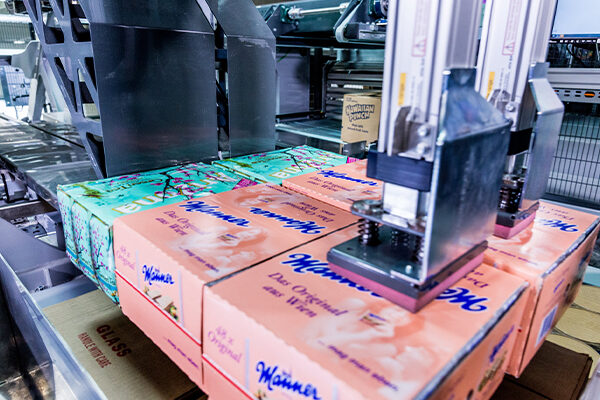
Warehouse Tetris – the art of the load
KiSoft Pack Master determines the ideal layout of items on load carriers – not just on pallets, but also in roll containers, plastic containers and cartons. The calculated layout maximizes stability, optimizes the use of space and fulfills store-specific packing criteria.
Both robots and humans benefit from the software. Our user-friendly work stations guide employees through picking at the station, making sure products are optimally placed in the container. If robots are used in the warehouse, the software determines not only the customer-specific packing pattern, but also the movement vectors for the robot.
The pros of calculating packing patterns stack up
With KiSoft Pack Master software, you benefit from:
Are you looking to optimize your packing patterns? Talk to our experts about packing pattern calculation.
Perfect packing patterns thanks to perfect master data
Managing master data is very resource intensive, but high-quality master data makes packing pattern calculation even better. Just the length, width, height and weight of an item is usually not sufficient. The more attributes of an item or load carrier are available to the software, the better it can optimize the calculation.
The intelligent algorithm integrates additional information such as how the product behaves when rotated or tipped and its compression strength, packaging material, and surface type (fully covered, windowed or with banding) to create even more stable packing patterns.
To make the recording of additional master data as easy as possible, we developed MultiScan as a solution to provide optimal support for this task and to reduce the time it takes to do it to a minimum.
We can also help you record the necessary data quickly, efficiently and precisely with our MultiScan dimensioning products.
Do you want to take your product master data to the next level?
FAQs – Key questions and answers
To achieve maximum stability, individual handling units are assembled in layers for store delivery with the help of artificial intelligence. Dynamic and static stability calculations and an overview of the physical conditions are taken into account to create interlocking layers. In e-commerce, the optimal placement inside the container is calculated.
Stores vary in layout as do the requirements to be considered when packing for store delivery. To provide an accurate store-friendly delivery, the individual parameters must be specified. Each store can therefore define its own individual packing pattern along with which items to keep together and which to keep apart. The criteria can be either hard or soft: A “hard” criterion must be fulfilled, but a “soft” criterion allows room for other optimizations. If there are no special criteria, then stability and volume optimization are the focus.
Correct master data is critical for smooth, automated processes. Incomplete or imprecise information can lead to sub-optimal results in the subsequent steps of storing, picking and delivering. Precise master data in comparison means that calculations for processes such as packing patterns and route planning are carried out in the best possible way.
Calculating packing patterns scales directly with the number of product and benefits from the available server performance. New calculations are typically completed within seconds, so they do not impact operations.
Calculating packing patterns with specialized software is relevant whenever it can positively influence downstream processes. For example, an optimally stacked store-friendly pallet saves time and trips back and forth when unpacked for the store. A good packing pattern also means optimally loading several different types of transport vehicles and load carriers, since load carriers have different maximum heights and weights depending on whether they’re transported by road or by air freight.
Yes, a visual depiction of the packing pattern is possible. The results can be displayed in different places, such as at a goods‑to‑person work station, to support employees step by step as they position products on the target load carrier.
Furthermore, there is a user interface that provides a detailed analysis of the packing pattern and the building sequence regardless of the type of work station.
