
Automated guided vehicles automate internal transport processes in manufacturing and warehousing. They bring efficiency, safety and flexibility to intralogistics. From definition to practice, discover what types of AGVs are available, where they are used and when they bring added value.
You are currently viewing placeholder content from Google Preferred Sources. To access the actual content, click the button below. Please note that this will result in data being shared with third parties.
More Information
Industry Solutions
Key Takeaways
What are automated guided vehicle systems (AGVS)?
Automated guided vehicle systems use automated guided vehicles to handle internal material transport in manufacturing, warehousing and intralogistics. They function without a human driver, semi- or fully autonomously.
What does an AGVS include?
An AGVS includes an automated guided vehicle (AGV), central control software, and technologies for safety and navigation.
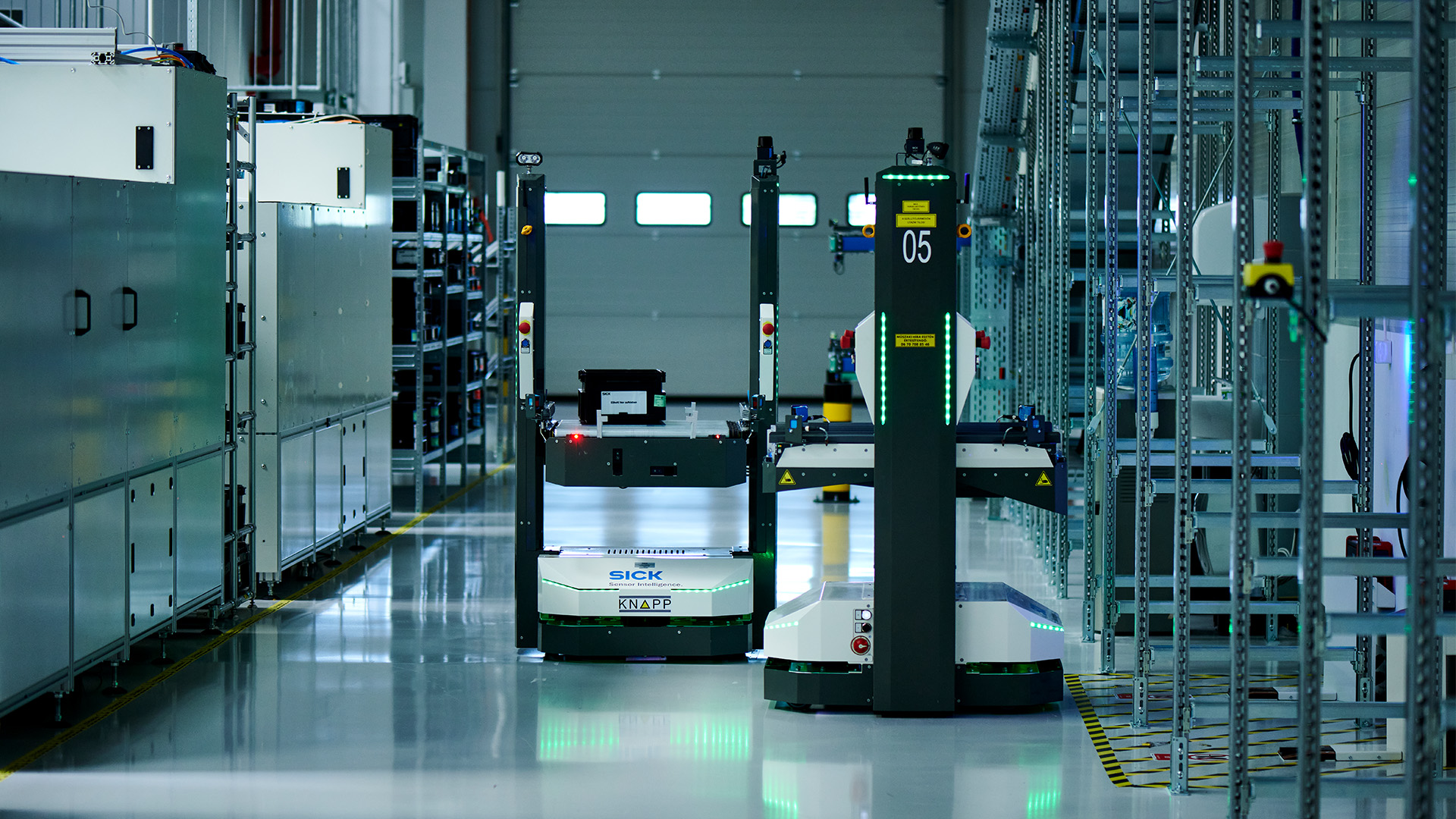
AGVS, AGV, AMR – what’s the difference?
Within the sector, the terms AGV and AMR are often used synonymously, but there are clear technical differences.
Term |
Definition and characteristics |
Classification |
| AGVS (automated guided vehicle system) | Internal, floor-based conveying system with automatically controlled vehicles used for material transport | Higher-level overall system |
| AGV (automated guided vehicle) | A single automated guided vehicle within the AGVS that handles transport tasks autonomously or semi-autonomously. A classic automated guided vehicle is usually with track-guided navigation along defined routes | Component of an AGVS |
| AMR (autonomous mobile robot) | Autonomously operating vehicle that uses technologies such as SLAM (simultaneous localization and mapping) to freely navigate, reading the environment and dynamically adapting its route. | Technological advancement of the AGV with greater autonomy. |
At KNAPP these types of vehicles fall under the term Open Shuttles which, technically speaking, are autonomous mobile robots. Find out more about AMRs in our blog “Autonomous Mobile Robots: Definition, Use, Advantages”.
Which transport system is suitable for different environments and applications?
While the conventional AGV works in clearly defined process environments, the autonomous mobile robot (AMR) is designed for much more flexible navigation. Which solution is the most suitable depends on factors such as process stability, transport frequency, environment and degree of integration.
For a detailed comparison of AMRs and AGVs, check out our blog: AMR and AGV: What’s the difference?

An AGV is the right choice when:
An AMR is the right choice when:

Expert tip: Today’s modern fleet control systems allow interoperability across manufacturers. Thanks to standards such as VDA 5050 (interface for the communication between automated guided vehicles (AGV) and a master control), AGVs, AMRs and manual handling equipment from different suppliers can work together the same system.
Why automated guided vehicles in intralogistics are more important than ever
Rising production volumes, shorter delivery times, growing product variety and persistent skilled labor shortages mean that companies have to design their internal material flows with more efficiency and flexibility. At the same time the requirements are increasing for process reliability, scalability and flexibility. Automated guided vehicle systems (AGVS) reliably handle repetitive, monotonous transport tasks. They free skilled employees for value-creating tasks, ensure consistent, safe transport and support plannable processes in operations.
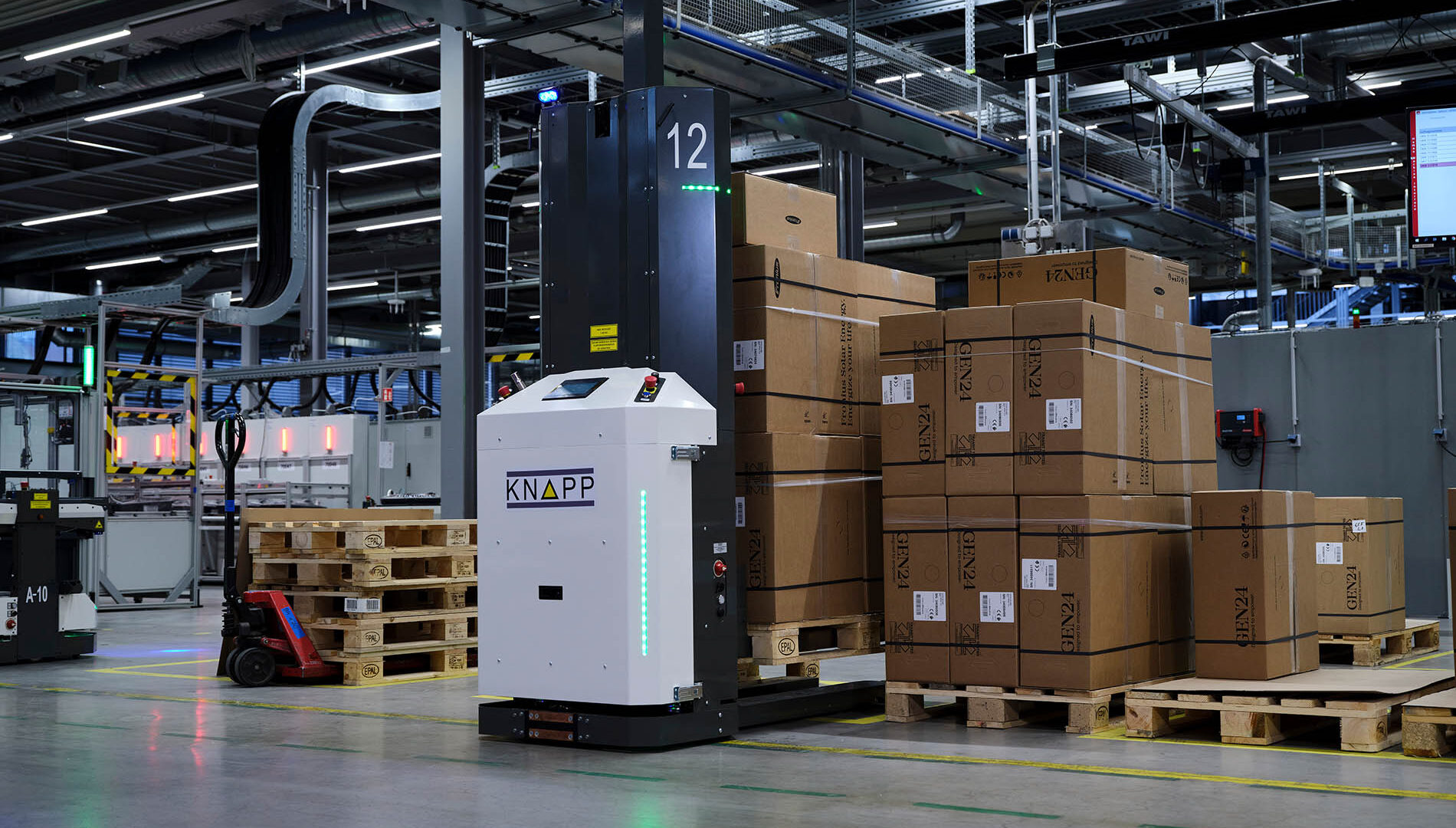
Market development and indexes: How the AGV market is developing
The market for mobile transport robots (AGVs and AMRs) is dynamic and growing worldwide. The global market volume in 2025 was at several billion USD and, in the coming years, will multiply significantly. Growth is forecast to reach double digit figures, with the market expected to reach 20 billion USD by the early 2030s. Europe is one of the most important regions worldwide, representing 30 % of the global market share, with an expected increase of more than 3 billion USD expected by 2030. [Grand View Research, Grand View Research Europe Outlook]
The number of systems operating is steadily increasing. In 2024 alone, around 200,000 professional service robots were sold, with more than half deployed in transport and logistics. As a result, robot systems have become one of the central drivers of growth in intralogistics. [International Federation of Robotics]
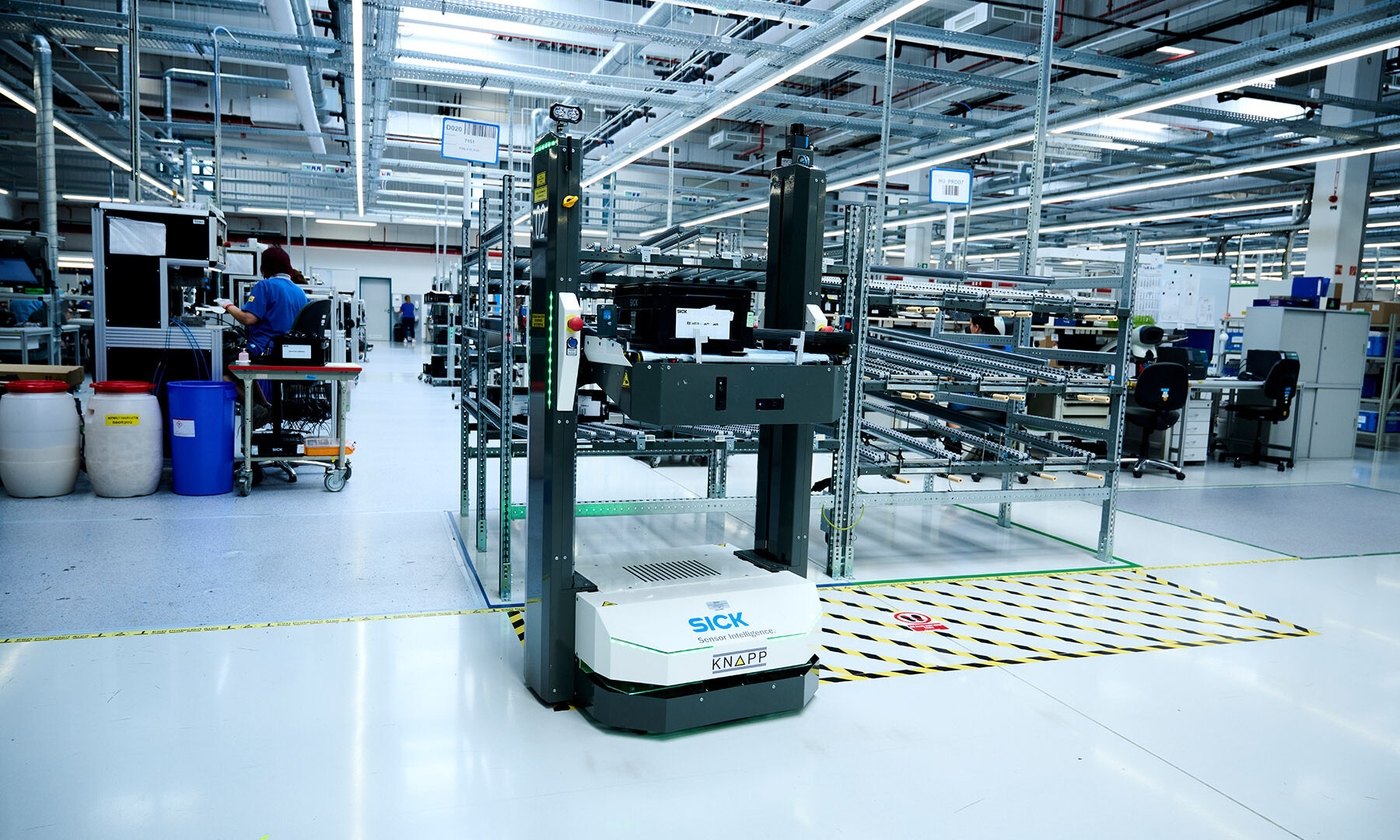
Experts predict annual growth rates (CAGR) of 8 % to 10 % for the AGV segment [Grand View Research]; for the AMR segment, the figure is between 14 and 19 % [Grand View Research, Global Market Insights].
Top trends in the AGV market
Autonomous navigation instead of fixed infrastructure
Smart fleet control and interoperability
Predictive maintenance and energy management
Types of automated guided vehicle systems
Automated guided vehicles exist in various designs used for different applications and transported materials. This includes platform AGVs, AGV forklifts, under-ride AGVs and towing AGVs, which perform specific transport tasks.
The difference is in the design, function and integrated load-handling device, such as a roller conveyor or lifting fork:
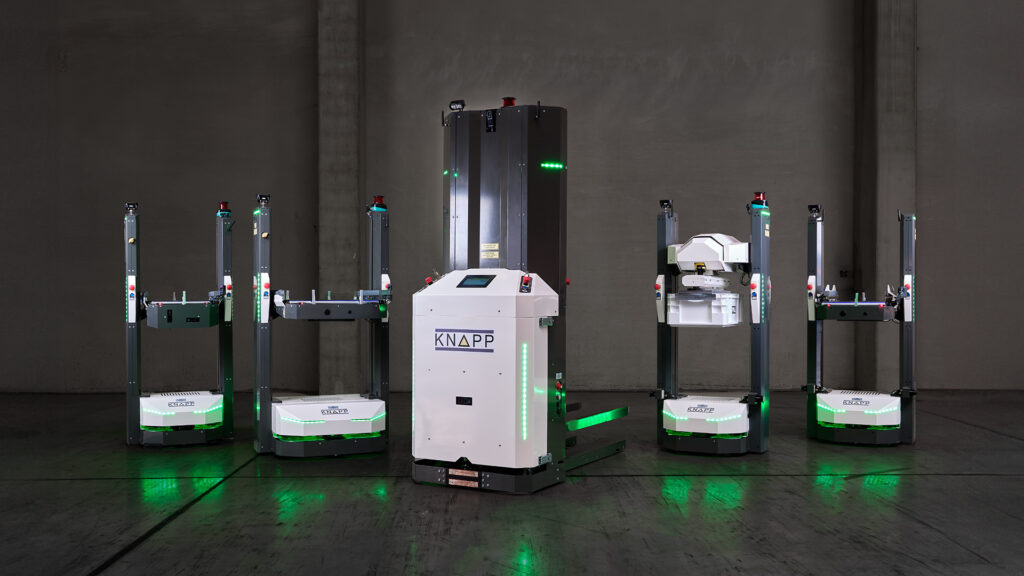
Platform AGVs
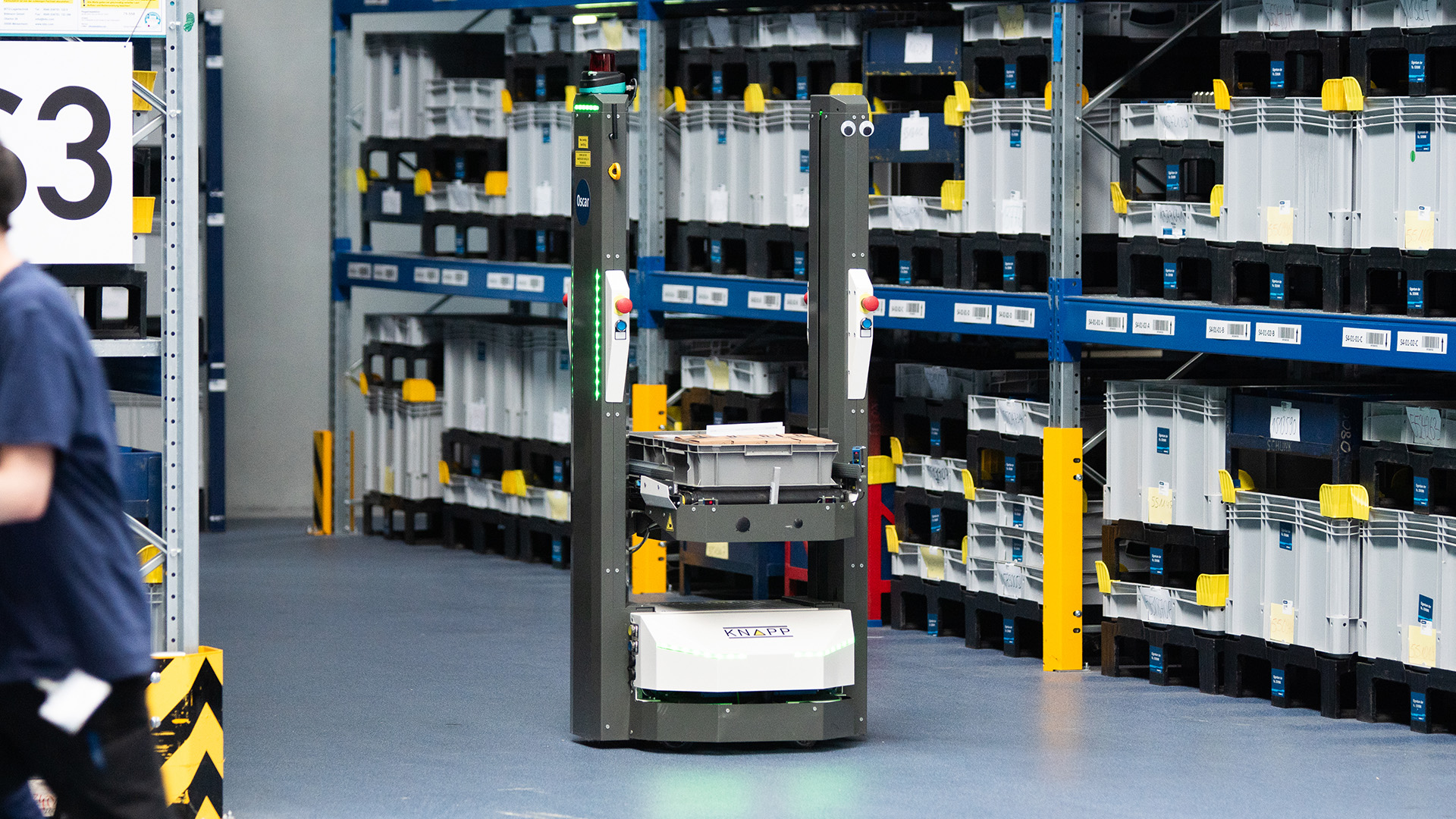
These robots are used in intralogistics and have a load bed to transport various types of load carriers (containers, cartons, etc.). With the Open Shuttles, KNAPP offers a broad portfolio:
Automated guided vehicles for container transport
The Open Shuttles are sophisticated AGVs that transport containers, cartons and trays weighing up to 120 kg (265 lb). Depending on the type, either one or two containers are transported at a time. Container transport solutions >
Automated guided vehicles for magazines and trays
The Open Shuttles efficiently transport magazines, reels and trays weighing up to 50 kg (110 lb). They have an integrated mechanism for width adjustment which allows them to secure and transport different widths of load carrier. Transport solutions for magazines and trays >
Towing AGVs
Towing AGVs tow one or more carts or trailers and are suited for larger quantities and longer distances.
AGV forklifts
An AGV forklift is an automated forklift truck that lifts pallets or special load carriers directly off the floor, from a rack or from a conveyor belt for transport.
Automated guided vehicles for pallets
The Open Shuttle Fork transports pallets, frames, racks or special load carriers with a weight of up to 1,300 kg (2,866 lb). Pallet transport solutions >
Under-ride AGVs/ Latent AGVs
These AGVs have a very flat design allowing them to run underneath pallets, carts and trolleys, racks or containers on jacks
Special solutions and heavy-duty AGVs
For unusual requirements, such as transporting long pipes, a heavy-duty AGV can be used. These are specially designed to transport large, heavy goods and are most commonly used in the automotive sector or in the steel industry.
Technologies and intelligence: How do automated guided vehicles work?
Automated guided vehicles use a combination of navigation technology, sensors and a central control software.
They gather data from their environment, plan routes automatically and complete their transport jobs – independently and harmoniously.
Navigation and sensors: from track guidance to free navigation
AGVs use different navigation processes to navigate their environments:
Track-guided navigation:
Marker-guided navigation:
Laser navigation / contour navigation:
SLAM navigation (simultaneous localization and mapping):
Camera-based navigation:
AGV software: Vehicle control and fleet management systems
Vehicle control and fleet management systems, including energy management, form the central brain of the autonomous mobile robot system. They handle the higher-level control of the material flow by coordinating routes, orders and fleet movements based on real-time data. Furthermore, they ensure that transport is planned and carried out efficiently and act as the interface between the hardware of the intralogistics system and the higher-level IT and warehouse management systems (WMS, WCS, ERP, etc.).
KiSoft FCS software for AMRs and AGVs manages, controls and coordinates all the transport orders for the Open Shuttles and manually operated warehouse transporters.
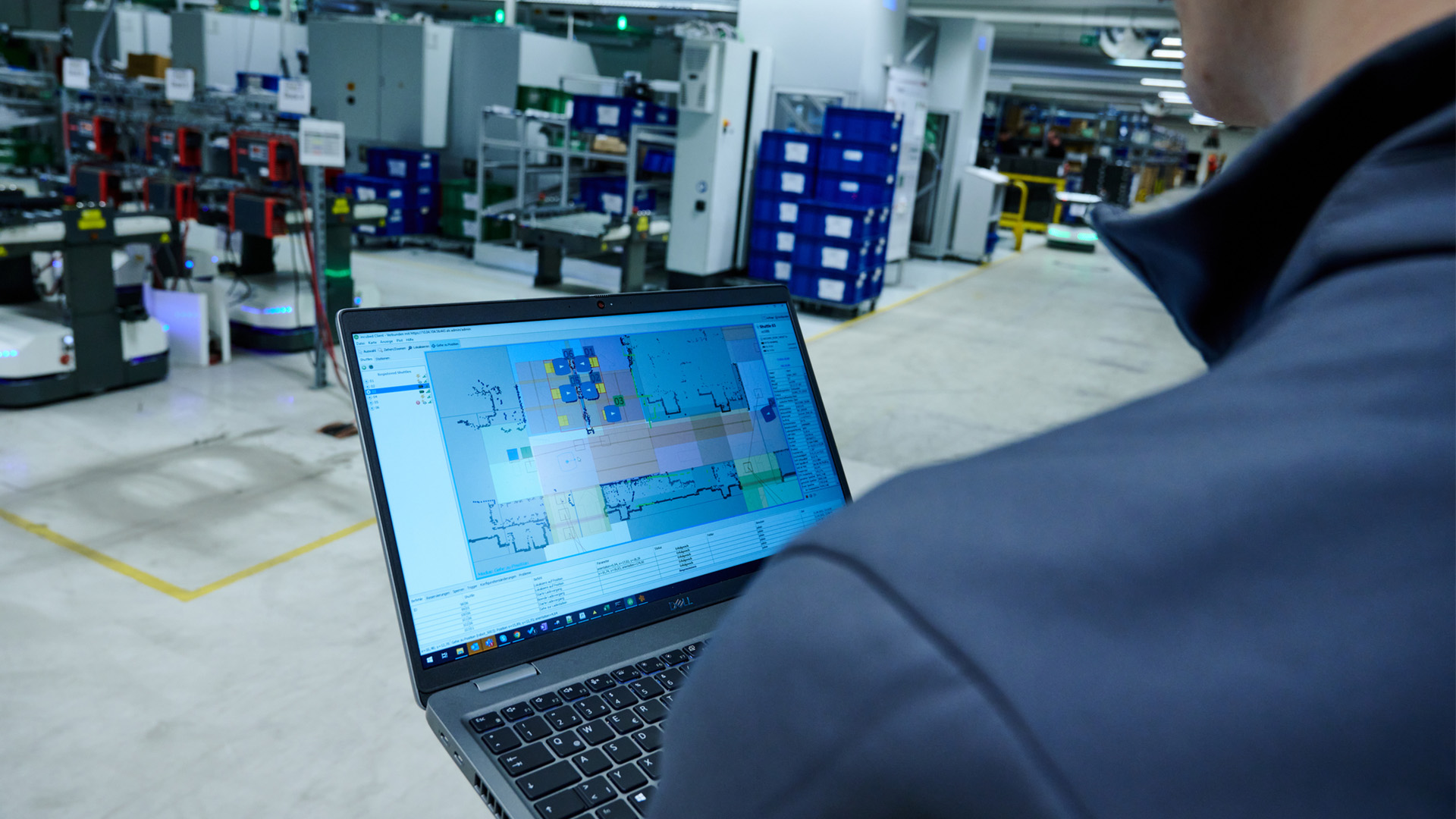
The exact difference is as follows:
Criterion |
Control system (vehicle control) |
Guidance system (fleet management) |
| Level | Vehicle | Overall system / fleet level |
| Location | In vehicle (AGV) | Server / central software |
| Tasks |
|
|
| Classification | Executes run commands | Generates and distributes run commands |
| Focus | Technical execution and safety | Efficiency and material flow |
Safety concepts and standards (ISO 3691-4)
Modern AGVs have several fields of safety which are monitored by laser scanners. If a person or obstacle is detected in the warning field, the AMR reduces its speed, whereas if a person or obstacle is in the protective field, it stops immediately.
The standard ISO 3691-4 defines the exact safety requirements and test methods and applies to both AGVs and AMRs. These requirements include:
Human and obstacle detection by certified sensor technology
Safe stop and emergency stop functions
Speed monitoring dependent on the environment and situation
Various operation modes like automatic, manual or servicing modes
As AGV and AMR systems are increasingly integrated, the functional safety and cybersecurity are both becoming more important. Modern systems rely on integrated safety and security concepts – from encrypted communication and clear access controls to sensor-based human detection systems in line with the standard ISO 3691-4.

Where are AGVs used in the real world?
Automated guided vehicle systems (AGVS) are used to optimize and automate internal material transport processes. They are widely used across sectors:
AGVs can be used everywhere where materials, goods, pallets or components need to be transported regularly and safely. Typical applications are internal transport, production supply, linking machines and picking.
Automated guided vehicle systems can be used indoors as well as outdoors.

What do automated guided vehicle systems cost and when does it pay to invest in one?
The costs of an automated guided vehicle system depend on the initial investments for hardware, software and infrastructure, integration into existing processes and ongoing operation costs like servicing and maintenance.
Despite the initial investments, AGVs are one of the most effective levers for raising efficiency and process stability in intralogistics. With automated, continuous transport, personnel can also be assigned more purposefully and errors reduced. From an economic point of view, automated guided vehicles achieve a return on investment (ROI) in 1–3 years, depending on how they are used, the shift model and company size.
Find out more about the costs of an automated guided vehicle system (AGVS) >
Automated guided vehicle systems: the pros and cons
Automated guided vehicle systems offer many advantages like greater efficiency, process reliability and supporting employees, but require careful planning and integration. Their profitability depends significantly on how they are used.
Pros AGVs
24/7 availability:
Employee workload eased:
Process stability:
Safety:
Space-efficient:
Transparency and traceability:
Scalability:
Cons AGVs
Planning expenses:
Investment costs:
Integration complexity:
Limited with highly variable processes:
IT infrastructure:
Process-dependent:
The takeaway: When does it pay to use an automated guided vehicle system (AGVS)?
Economically speaking, using an automated guided vehicle system will pay off where the costs of internal transport make up a major portion of process costs and simultaneously create little value.
Checklist: AGV, yes or no?
FAQ – frequently asked questions on automated guided vehicle systems
What is the most significant difference between an AGV and an AMR?
The classic automated guided vehicle system (AGVS) follows a set path and stops for obstacles, while the autonomous mobile robot (AMR) has intelligent software and sensors allowing it to independently move around obstacles, flexibly adapting its route.
Are AGVs safe in mixed operations with people?
Yes. Automated guided vehicles as well as the Open Shuttles fulfill the strict requirements of the standard ISO 3691-4. They have safety functions such as laser scanners, obstacle detection, speed adjustments and emergency stop functions.
Can a fleet of automated guided vehicles be expanded later on?
Yes. AGVs and in particular AMR-based systems like the Open Shuttles are designed with fleet scalability in mind. Shuttles can be added one by one, routes adapted, and transport tasks expanded, often without major changes to the existing infrastructure.
What sectors are AGVs particularly suited to?
Automated guided vehicle systems are used across sectors, for example in the automobile industry, machine construction, e-commerce, retail and in the pharmaceutical and food industries.
What does an automated guided vehicle system cost?
The costs of an automated guided vehicle system (AGVS) depend on factors such as the vehicle type, number of vehicles, software, integration costs and infrastructure needs. Realistically, the total costs include not only the initial investment for the hardware and software, but also ongoing costs for maintenance, service and operation.
Find out more about the costs of an automated guided vehicle system (AGVS) >
Let’s talk about your automation project!